
TJ3SP & TJ3FR
Cameroon - October 2004
Facts about Cameroon
 The
former French Cameroon and part of British Cameroon merged in 1961 to form
the present country. Cameroon has generally enjoyed stability, which has
permitted the development of agriculture, roads, and railways, as well as
a petroleum industry. Despite movement toward democratic reform, political
power remains firmly in the hands of an ethnic oligarchy.
The
former French Cameroon and part of British Cameroon merged in 1961 to form
the present country. Cameroon has generally enjoyed stability, which has
permitted the development of agriculture, roads, and railways, as well as
a petroleum industry. Despite movement toward democratic reform, political
power remains firmly in the hands of an ethnic oligarchy.
Geography Cameroon |
|
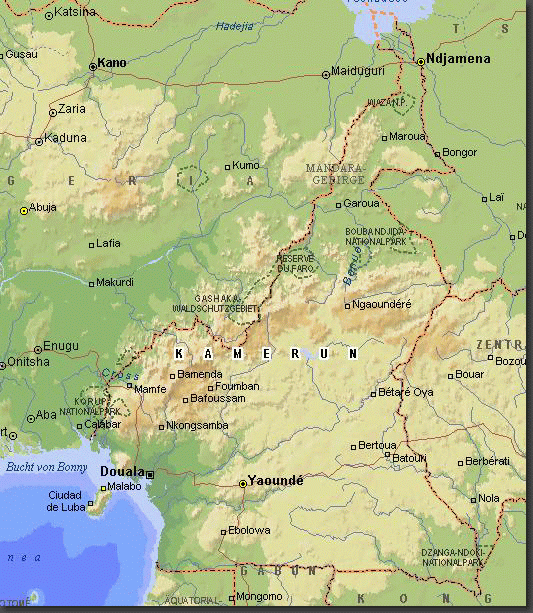
| Location: | Western Africa, bordering the Bight of Biafra, between Equatorial Guinea and Nigeria |
| Geographic coordinates: | 6 00 N, 12 00 E |
| Area total: | 475,440 sq km water: 6,000 sq km land: 469,440 sq km. Area - comparative: slightly larger than California |
| Land boundaries: | 4,591 km. Border countries: Central African Republic (TL), Chad (TT), Republic of the Congo (TN), Equatorial Guinea (3C), Gabon (TR), Nigeria (5N). |
| Coastline: | 402 km |
| Climate: | varies with terrain, from tropical along coast to semiarid and hot in north |
| Terrain: | diverse, with coastal plain in southwest, dissected plateau in center, mountains in west, plains in north |
| Elevation extremes: | highest point: Fako (on Cameroon Mountain) 4,095 m |
| Natural resources: | petroleum, bauxite, iron ore, timber, hydropower |
| Land use: | arable land: 13% permanent crops: 3% other: 84% (1998 est.). Irrigated land: 330 sq km (1998 est.) |
| Natural hazards: | volcanic activity with periodic releases of poisonous gases from Lake Nyos and Lake Monoun volcanoes |
| Geography - note: | sometimes referred to as the hinge of Africa; throughout the country there are areas of thermal springs and indications of current or prior volcanic activity; Mount Cameroon, the highest mountain in Sub-Saharan west Africa, is an active volcano |
People Cameroon |
|
| Population: | 16,184,748 note: estimates for this country explicitly take into account the effects of excess mortality due to AIDS; this can result in lower life expectancy, higher infant mortality and death rates, lower population and growth rates, and changes in the distribution of population by age and sex than would otherwise be expected (July 2002 est.) |
| Population growth rate: | 2.36% (2002 est.) |
| Infant mortality rate: | 68.79 deaths/1,000 live births (2002 est.) |
| Life expectancy at birth: | 55.23 years (2002 est.) male: Total fertility rate: 4.72 children born/woman (2002 est.) |
| HIV/AIDS: | adult prevalence rate: 7.73% (1999 est.) - people living with HIV/AIDS: 540,000 (1999 est.) - deaths: 52,000 (1999 est.) |
| Nationality: | noun: Cameroonian(s) adjective: Cameroonian |
| Ethnic groups: | Cameroon Highlanders 31%, Equatorial Bantu 19%, Kirdi 11%, Fulani 10%, Northwestern Bantu 8%, Eastern Nigritic 7%, other African 13%, non-African less than 1% |
| Religions: | indigenous beliefs 40%, Christian 40%, Muslim 20% |
| Languages: | 24 major African language groups, English (official), French (official) |
| Literacy: | definition: age 15 and over can read and write. Total population: 63.4% male: 75% female: 52.1% (1995 est.) |
Government Cameroon |
|
| Country name: | Republic
of Cameroon conventional short form: Government type: unitary republic;
multiparty presidential regime (opposition parties legalized in
1990) note: preponderance of power remains with |
| Capital: | Yaounde |
| Administrative divisions: | 10 provinces; Adamaoua, Centre, Est, Extreme-Nord, Littoral, Nord, Nord-Ouest, Ouest, Sud, Sud-Ouest |
| Independence: | 1 January 1960 (from French-administered UN trusteeship) |
| Constitution: | 20 May 1972 approved by referendum; 2 June 1972 formally adopted; revised January 1996 |
| Legal system: | based on French civil law system, with common law influence; has not accepted compulsory ICJ jurisdiction |
Economy Cameroon |
|
| Economy - overview: | Because of its oil resources and favorable agricultural conditions, Cameroon has one of the best-endowed primary commodity economies in sub-Saharan Africa. Still, it faces many of the serious problems facing other underdeveloped countries, such as a top-heavy civil service and a generally unfavorable climate for business enterprise. Since 1990, the government has embarked on various IMF and World Bank programs designed to spur business investment, increase efficiency in agriculture, improve trade, and recapitalize the nation's banks. In June 2000, the government completed an IMF-sponsored, three-year structural adjustment program; however, the IMF is pressing for more reforms, including increased budget transparency and privatization. International oil and cocoa prices have considerable impact on the economy. |
| GDP: | Purchasing power parity - $26.4 billion. Real growth rate: 4.9%. Per capita: purchasing power parity - $1,700. Composition by sector: agriculture: 44% industry: 20% services: 36% (2000 est.). |
| Population below poverty line: | 48% (2000 est.) |
| Household income or consumption by percentage share: | lowest
10%: NA% highest 10%: NA% |
| Inflation rate (consumer prices): | 2% (2000 est.) |
| Unemployment rate: | 30% (2001 est.) |
| Industries: | petroleum production and refining, food processing, light consumer goods, textiles, lumber |
| Industrial production growth rate: | 4.2% (1999 est.) |
| Agriculture - products: | coffee, cocoa, cotton, rubber, bananas, oilseed, grains, root starches; livestock; timber |
| Exports - commodities: | crude oil and petroleum products, lumber, cocoa beans, aluminum, coffee, cotton |
| Exports - partners: | Italy 24%, France 18%, Netherlands 10% (2000 est.) |
| Currency code: | XAF |
Communications Cameroon |
||
| Telephones - main lines in use: | 95,000 (2001) | |
| Telephones - mobile cellular: | 300,000 (2002) | |
| Radio broadcast stations: | AM 11, FM 8, shortwave 3 (1998) | |
| Radios: | 2.27 million (1997) | |
| Television broadcast stations: | 1 (1998) | |
| Televisions: | 450,000 (1997) | |
| Internet country code: | .cm | |
| Internet Service Providers (ISPs): | 29 (2002) | |
| Internet users: | 20,000 (2000) note: in 2000, Cameroon also had 112 cyber-cafes | |
Transportation Cameroon |
||
| Railways: | total: 1,104 km narrow gauge: 1,104 km 1.000-m gauge (1995 est.) | |
| Highways: | total: 34,300 km paved: 4,288 km unpaved: 30,012 km (1995) | |
| Waterways: | 2,090 km (of decreasing importance) | |
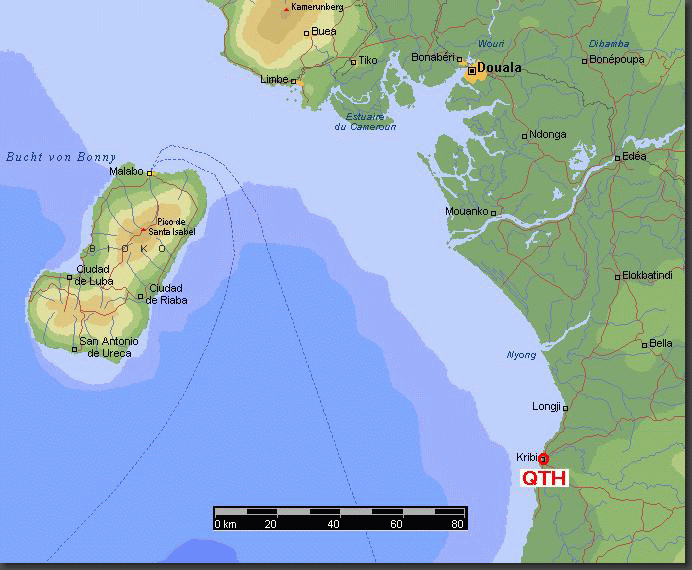
| Ports and harbors: | Bonaberi, Douala, Garoua, Kribi, Tiko | |
| Airports: | 49 (2001) | |
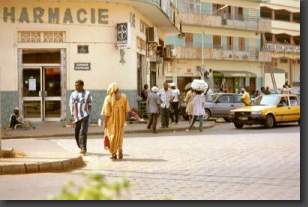
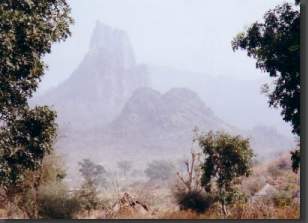
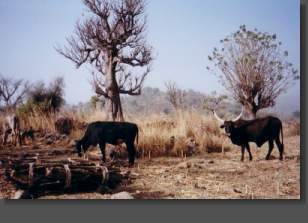
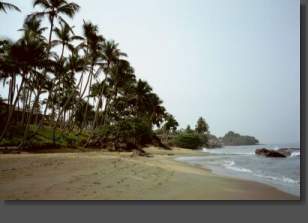
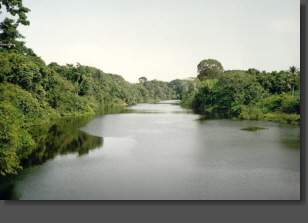
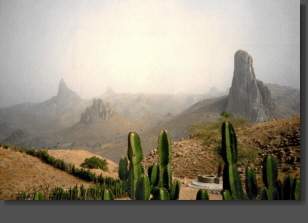
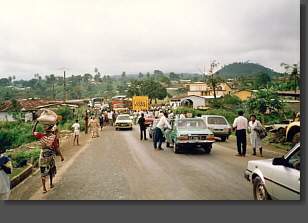
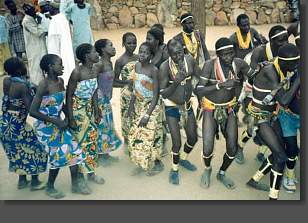
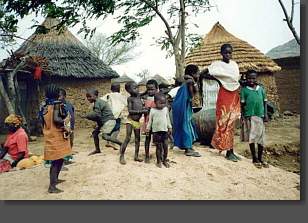
Here we want to give you some photo impressions of our host country Cameroon.
 |
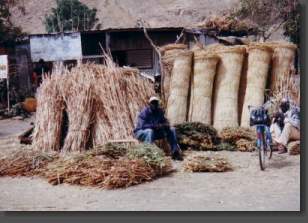 |
| Yaounde street scene | Maroua street scene |
 |
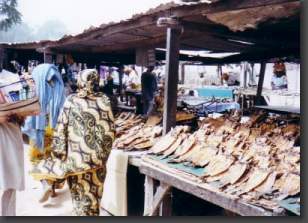 |
| Rhumski region | Maroua market scene |
 |
|
| Rhumski region | |
 |
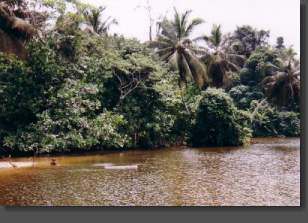 |
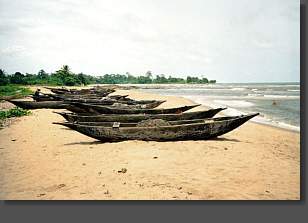
| Kribi beach | Kribi lagoon |
 |
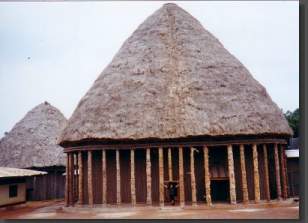 |
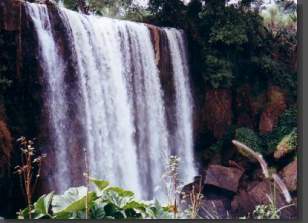
| Bafoussan Mifi waterfall | Bandjoun meeting house |
 |
 |
 |
 |
 |
 |